
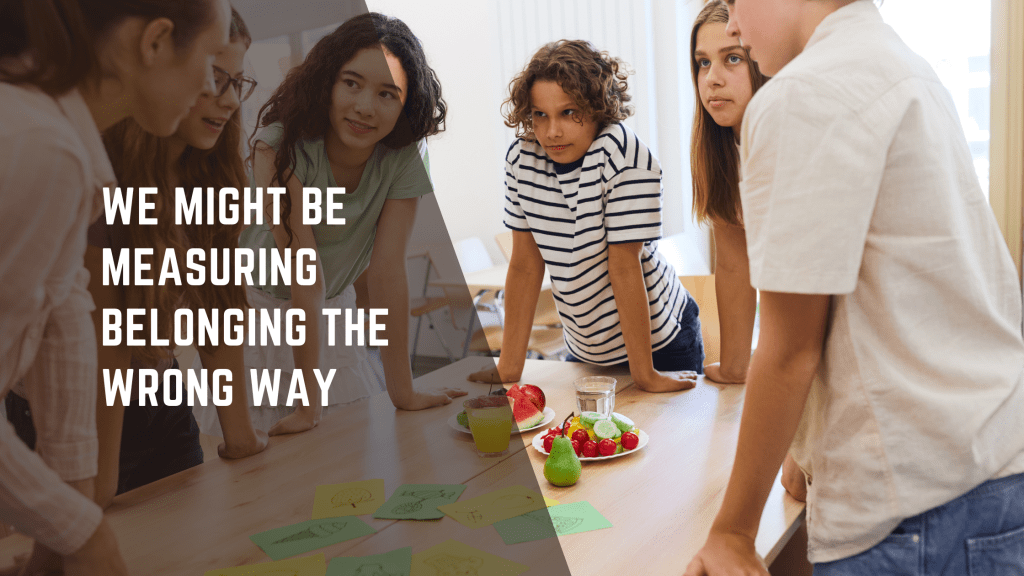
When schools talk about belonging, we usually begin with a straightforward question: Do students feel like they belong here? Sometimes we add another: Do students feel like they have someone they can talk to if they have a problem?
These are important questions. I believe in asking them. If adults in a building never ask students directly about their experience, we are left trying to piece together a sense of belonging from behavior, attendance, or academic performance.
But lately, I’ve been wondering whether asking students directly about their sense of belonging, by itself, is too narrow a way to understand it.
Belonging is certainly a feeling. But it is also something observable. It shows up in patterns, in choices, in relationships. If belonging is real, it should leave traces in the social landscape of a classroom.
Who Do Students Choose?
In every classroom, the patterns of who students choose to work with and spend time with begin to reveal the structure of belonging, including who is consistently included and who quietly is not.
Some students are named again and again. Others move between groups without anchoring in one. And some are rarely named at all.
This does not automatically signal a problem. But when certain students are consistently chosen, and others rarely are, that pattern tells us something about how belonging is functioning within the room.
Belonging is partly about feeling accepted. It is also about being chosen. When a student is repeatedly invited to work with others and included in conversations, it reinforces their place. When that invitation rarely comes, the absence can shape how that student experiences school, even if they never articulate it directly.
How Widely Are Students Connected?
Frequency alone does not tell the whole story. A student may be chosen often, yet only by the same few peers.
Close friendships matter. But there is a difference between being anchored in one small circle and being connected across the classroom.
When connections extend across multiple groups and are returned consistently, belonging tends to feel more secure. When connection is concentrated or one-sided, it can be more fragile. If that small circle shifts, the student’s sense of place may shift with it.
Looking at the distribution and steadiness of connection helps us understand not just whether a student is connected, but how stable that connection may be.
What Role Does Each Student Play?
As I continued thinking about belonging, I realized it is not only about how many connections a student has, but about the role they play within the social landscape of the classroom.
In every room, some students naturally draw others in. Some move easily between groups. And some keep more to themselves.
These roles shift over time, but they influence how belonging feels.
A student who bridges groups may feel broadly connected. A student who draws others in may feel secure yet carry social weight. A student who keeps more to themselves may not feel excluded, yet their distance from the center can shape how visible they are.
Belonging has structure. And that structure influences daily experience more than we often acknowledge.
Where This Leaves Me
The more I think about belonging, the more layered it becomes.
Students can tell us how they feel. Their patterns of connection reveal their positioning.
And still, that may not be the whole story.
Belonging is not only peer-based. Adults matter deeply. A student may sit at the edges socially and still feel anchored because one teacher knows them well.
No single question captures belonging. No single view explains it fully.
What I am increasingly convinced of is this: if we want to strengthen belonging, we may need better ways to actually see it.
I am still thinking through these ideas. I would be curious how others approach this in their own classrooms or schools.
When you think about belonging, what signals do you pay attention to beyond what students report?
About the Author
Adam Rockenbach is the co-founder of Bloomsights and a former secondary history teacher.
If you’re interested in exploring how Bloomsights helps schools understand student connection and belonging at a deeper level, you can learn more here.



Leave a Reply